
Marion County 72-Hour Feed Is Absent
The Multi-County Correctional Center has no public 72-hour archive. The Marion County Sheriff also provides no rolling release page. Its official site links users to MCCC and Ohio VINE instead of a sheriff jail roster. No verified local source publishes a three-day URL, visible fields, refresh cadence, online retention rule, or booking-photo column. An out-of-state site with “Marion” in its name is not a safe substitute.
The correct three-day method starts with MCCC's records. Ask whether an existing release or transfer report can be produced for a stated beginning and ending timestamp. Ohio jail rules require internal commitment and release-to-agency documentation even though the facility does not show it online. If the database already supports a standard report, the custodian can assess the request as one for an existing record. The office need not create a new analysis or research a vague date range.
Marion County Exact Release Window
“Last three days” can shift with the hour of the request. It can also blur a weekend boundary. Use full dates and local times, such as a start at the beginning of the first calendar day and an end at the close of the third. If daylight-saving time changes within the span, ask the custodian to use its system timestamps. This prevents the same release from falling outside one person's informal count but inside another's.
The research supplies a practical request: “Please provide the existing MCCC release/transfer report, if maintained and producible through the jail-management system's standard reporting functions, for the stated start date and time through the stated end date and time, including booking number, name, booking date, release/transfer date/time, release authority/type, and receiving agency where applicable, with exempt fields redacted.” Ask how the data is maintained if staff says the wording is too broad.
Note: Preserve the timezone, request time, and response time so a later movement is not mistaken for an error in the first result.
Check Marion County 72-Hour Releases
The longer range should be worked as a records task, not a scan of current names. A current-custody answer is still useful, but it cannot reconstruct every movement over three days. Pair it with the exact-interval report, the right Marion court, and a custody notification source.
- Set firm boundaries. Write the beginning and ending date, time, and local timezone.
- Call MCCC. Dial 740-387-7434 and press 2 to ask whether a named person is incarcerated now.
- Request the interval. Ask the MCCC records custodian for the existing release or transfer report between those timestamps.
- Read the destination. Treat another jail, ODRC, or another agency as continued custody.
- Match the court event. Check Municipal Court for local cases and Common Pleas for felony disposition or sentencing.
- Use VINE as corroboration. Confirm any alert with MCCC or the receiving agency.
If the event appears to have happened today, the 24-Hour Releases method narrows the interval. For a person whose custody history is unclear, use the Marion County released inmate search to identify the correct local, state, or federal system.
Marion County 72-Hour Release Fields
Because no public list exists, these are requested record fields rather than website columns. Together they answer who left MCCC, when that custody ended, the authority for the movement, and whether another agency received the person. Names alone do not resolve those questions. A booking number helps distinguish repeat commitments and similar names.
| Field | Why it matters across three days |
|---|---|
| Name and booking number | Ties each movement to one MCCC commitment. |
| Booking date and time | Separates a new booking from an older custody period. |
| Release or transfer timestamp | Places the movement inside or outside the defined window. |
| Release authority or type | Shows the recorded legal basis without guessing from a status. |
| Receiving agency or officer | Shows that custody continued after an MCCC transfer. |
| Charge and commitment authority | Points to the court record that should explain the legal event. |
A property receipt may support the sequence of release processing because Ohio standards require a receipt when property is returned at release or transfer. It does not prove where the person went. If part of a report is exempt, request the non-exempt fields with lawful redactions and ask for the authority behind any withheld portion.
Marion County Weekend Release Lag
A three-day span is most useful when court, jail, and public web updates fall on different days. Marion Municipal Court warns that filings and judicial action may take at least 24 hours to appear online. A release processed late Friday can therefore precede a visible docket update. A holiday can add another gap. Common Pleas felony entries must be checked in its separate eServices system.
The docket and jail record serve different roles. A bond order, dismissal, sentence, or judicial entry explains legal authority. The MCCC release timestamp shows when the jail acted. Even after an order is entered, identity checks, another hold, transport, or ordinary processing can delay the movement. Do not backfill a jail exit time from the court filing time.
Use Marion Municipal Court record search with its posting warning in mind, and check Marion County Common Pleas eServices when the matter is a felony. A verified court copy can settle the order's terms, while MCCC remains the source for physical release or transfer time.
Note: Courts may close on legal holidays, but MCCC custody movements and jail processing do not become a public online feed.
Marion County Phone Release Records
MCCC's official inmate-information page tells users to call 740-387-7434 and press 2 for a current incarceration check. A “not here” answer applies at the time of the call. It cannot reveal whether the person spent part of the prior three days at MCCC, nor does it distinguish community release from transfer. Ask for the dated entry next.
The official screen documents that custody-check route and related release guidance.
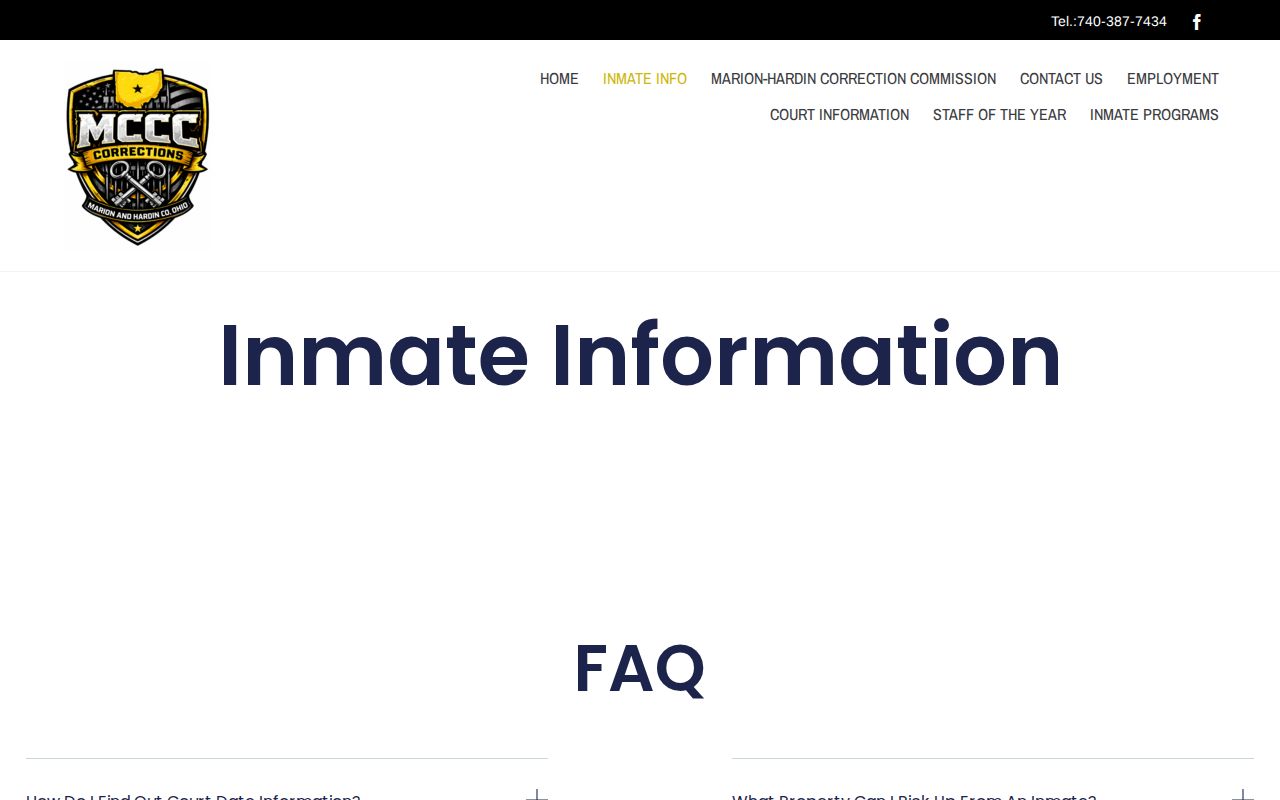
The screenshot supports a phone-and-records fallback, not a claim that MCCC maintains a public three-day archive.
MCCC is operated through the Marion-Hardin Corrections Commission. Start at 1514 Victory Road, Marion, OH 43302, or by phone, and ask who acts as public-records custodian. The Sheriff's records portal and policy provide a county request channel, but its fees should not be assigned to MCCC without confirmation from the commission.
For an older movement within the selected span, identify the booking period as well as the person's name. MCCC may have more than one commitment for the same person. A booking number prevents the custodian from pairing the wrong release with the request. If no standard three-day report is available, request the individual release entries or ask how the commission indexes them.
Marion County Sheriff Release Routing
The sheriff's official page is useful because it shows the local routing. Jail questions go to MCCC, while custody notifications go to VINE. It does not expose an inmate roster or recent-release list. That negative fact helps avoid unofficial pages that mix Marion County, Ohio with places of the same name elsewhere.
The Marion County Sheriff page pictured below links to the correct local jail and notification resources.
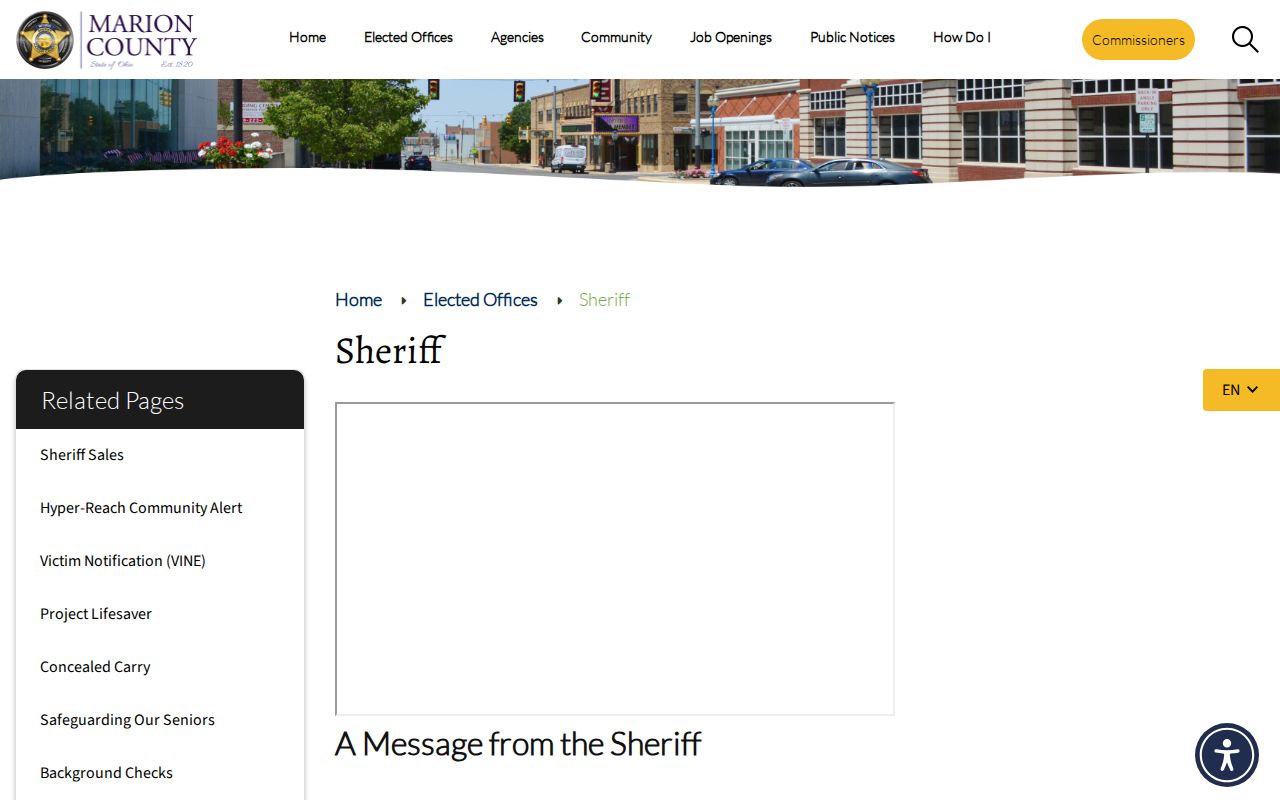
Its routing confirms why a three-day search must use MCCC records rather than a sheriff-hosted feed.
Ohio VINE can send county-jail release and transfer notices after prospective registration. It is not a retrospective list of everyone who left during the prior 72 hours. A notice should be paired with the MCCC record because agency feeds can lag and a transfer does not mean community release.
Marion County Release or Transfer Results
Read every MCCC movement by custody level. A bond, recognizance order, dismissal, time served, sentence completion, or other court order can lead to community release. A felony prison sentence may instead lead to ODRC. A warrant from another county can lead to that jail. A detainer can cause an immediate handoff. Death must never be described as a community release.
If the report names ODRC, search the state offender system after allowing for intake entry. A move to Marion Correctional Institution or North Central Correctional Complex remains imprisonment even though both facilities are in Marion County. If the court shows a local community-control sentence, verify supervision with the proper court office. VINE provides a second custody signal, not the full chain.
The best proof is a matched pair: MCCC's exact release or transfer entry plus the court order or receiving-agency record. Conflicts can arise when one system updates before another. Save the dates retrieved, identify which office owns each field, and request a correction from that office. One custodian cannot change another agency's database.
Note: A three-day result is complete only when the movement type, exact time, legal authority, and destination have all been checked.