
Marion County Release Meanings
A release means one custodian ended its legal hold. At the Multi-County Correctional Center, that can be a direct exit on bond, recognizance, dismissal, time served, sentence completion, probation, or another court order. It can also be a transfer to the Ohio Department of Rehabilitation and Correction, another county jail, a treatment placement, or a different agency. Transfer is continued custody. Death ends ordinary custody but is not a community release. The exact MCCC release or transfer entry is needed before any broad claim is made.
State-prison records use different terms. Parole is release from an eligible prison sentence under Adult Parole Authority supervision. Post-release control is supervision after a qualifying felony prison term. Judicial release comes from the sentencing court and commonly places the person on community control. Discharge means the relevant custody or supervision obligation has ended. A person can therefore be out of a prison yet remain under APA supervision, or be gone from MCCC because ODRC took custody.
| Exit type | What it means | Best next record |
|---|---|---|
| Bond or recognizance | Pretrial jail custody ended under court terms | MCCC release entry and court bond docket |
| Time served or expiration | The local term was calculated as complete | Judgment, jail-time credit, and MCCC timestamp |
| ODRC transfer | County jail custody ended but state custody began | Transfer entry and ODRC Offender Search |
| Parole, PRC, or judicial release | Prison custody changed to supervised status | ODRC detail and APA or court record |
| Another detainer | A different agency immediately took custody | Receiving-agency field and that agency's locator |
Marion County Release Record Fields
An MCCC release record should identify the commitment being discussed and the event that ended it. Ohio jail standards require a booking and identification record for each commitment. When a person is released to another agency, the jail documents the receiving officer or agency, the date and time, and the authority for release. A receipt is also required for property returned on release or transfer. These internal records matter because MCCC does not publish a searchable archive of former detainees.
The most useful request asks for existing fields, not an explanation written from scratch. Give the full name, date of birth, and approximate commitment date. If known, include the booking or court case number. Ask for the booking and identification record, exact release or transfer date and time, release authority, destination or receiving agency, and property receipt. The record should then be paired with the court order or receiving agency record.
| Field | What it shows |
|---|---|
| Booking number and identity | Links the event to the correct commitment and person |
| Commitment date and authority | When custody began and which court or agency ordered it |
| Charge or case | The matter tied to that jail stay |
| Release or transfer timestamp | When MCCC physically ended its custody |
| Release authority | The court order, sentence event, or other legal basis |
| Receiving agency | Whether custody continued somewhere else |
| Property receipt | Documents return of property during exit processing |
Note: A property receipt supports the processing timeline, but it does not establish the legal reason for release by itself.
Request Marion County Release Records
Start a local jail request with MCCC inmate information at 1514 Victory Road, Marion, Ohio 43302, or call 740-387-7434. Ask who serves as records custodian for the Marion-Hardin Corrections Commission. The Marion Sheriff records page and its policy provide another official local route, but the sheriff's fee schedule should not be assumed to govern the separate corrections commission.
Ohio permits oral or written public-record requests. The sheriff's policy says a requester need not identify themselves or state a purpose, and the office must first explain why optional details would help before asking for them. Inspection is offered during stated weekday business hours. Copies must be produced within a reasonable time, not a fixed number of days. Volume, location, redaction, and legal review can affect the response.
- Identify one person and the approximate MCCC commitment period.
- Ask for the existing booking record and exact release or transfer entry.
- Name the date, authority, destination, property receipt, and booking photo fields sought.
- Ask for segregable non-exempt fields and a legal citation for any denial.
- Match the result to the court order or receiving custodian.
Ohio public-record law does not require an office to create a new report or perform research. A narrow request for maintained fields is easier to process.
Marion Release Records and Sealing
The Ohio Public Records Act, ORC 149.43, requires prompt inspection and copies within a reasonable period, subject to exclusions and lawful redaction. Ohio jail standards in OAC Chapter 5120:1-8 support the commitment and release-to-agency fields that can be named in an MCCC request. Juvenile, medical, security-sensitive, victim, personal-identifier, investigative, sealed, or expunged material may be restricted.
A name disappearing online is not a retention rule. MCCC has no public release archive from which an online retention window can be measured. Internal records remain subject to the custodian's adopted retention schedule. Ohio sealing and expungement under ORC 2953.32 and 2953.33 can restrict public court access, but eligibility depends on the conviction and history. An empty court search may therefore reflect legal restriction, delay, spelling, or scope rather than proof that no case existed.
Marion County Bond Release Steps
Marion has a specific bond route. The MCCC service page says Marion Municipal Court cash and corporate bonds are paid at MCCC. It also links a Municipal online bond-payment option that requires inmate ID and basic information. Marion Common Pleas bonds are posted at Common Pleas in downtown Marion. The court named on the case controls which route applies.
Payment starts a process. It is not proof that the person has crossed the exit point. Identity checks, paperwork, another warrant, a detainer, transport, or a second case may delay or prevent direct release. After payment, call MCCC and press 2 to ask whether the person remains incarcerated. For a firm record, match the bond receipt or court docket to MCCC's exact release time and authority.
Note: Confirm physical release after bond payment because another warrant, hold, or processing step can keep custody in place.
Property After Marion County Release
MCCC publishes a narrow pre-release property rule. A person in custody may release keys, credit cards, debit cards, EBT cards, or another document to a collector, and the item must bear the collector's name. This is not a general property-pickup promise. The facility does not publish the final exit door, release hours, family waiting area, weekend process, or transport plan, so those details must be asked directly.
Ohio jail standards separately call for a receipt when property is returned at release or transfer. If an item is missing or the receipt conflicts with the release record, identify the exact commitment and ask MCCC about that record. One custodian cannot fix another's data. A court corrects its docket, MCCC addresses its jail record, and ODRC Central Records reviews state corrections fields.
Marion Release Account Balances
MCCC's commissary information says remaining account funds at release or transfer are applied to “pay-for-stay.” The published source does not state an assessment rate or a full collection method. Those details should not be guessed. For one person, ask MCCC for the policy in force, the account statement, and the record showing how the balance was applied.
This financial step does not reveal the legal form of exit. It can occur on release or transfer. Use the release authority and receiving-agency fields to decide whether the person returned to the community, entered state custody, or went to another agency.
Search Marion County Released Inmates
The gold-standard search begins with the likely custodian. A Marion arrest, misdemeanor, pretrial hold, or local jail sentence points to MCCC. A felony prison sentence points to ODRC. A federal conviction points to the Bureau of Prisons. An immigration handoff points to ICE. A current roster only answers whether the person is held now. A release record answers when that custodian ended its hold and under what authority.
- Call MCCC at 740-387-7434 and press 2 for current incarceration.
- If the person is not there, request the dated release or transfer entry.
- Search ODRC by name and offender number across Released, APA Supervision, and Violators at Large.
- Check Municipal Court and Common Pleas for the order or sentence.
- Use Ohio VINE as a second signal, then verify the event with the custodian.
- Use BOP or ICE only when the case or transfer record points to those systems.
A released person usually drops from a live jail roster. “Not currently incarcerated” can still mean transfer, so obtain the dated exit record.
ODRC Marion Release Search
The ODRC Offender Search covers people in Ohio prisons, under Department supervision, or judicially released. It does not cover a person whose only custody was at MCCC. Start with a last name, add the first name, or use the full offender number. Search the Released, APA Supervision, and Violators at Large filters separately. County of Commitment points to the first reported commitment county and is not the same as the prison's physical location.
The official search screen shows how Marion County released-inmate criteria differ from a jail roster. Open the ODRC search source before using the fields shown below.
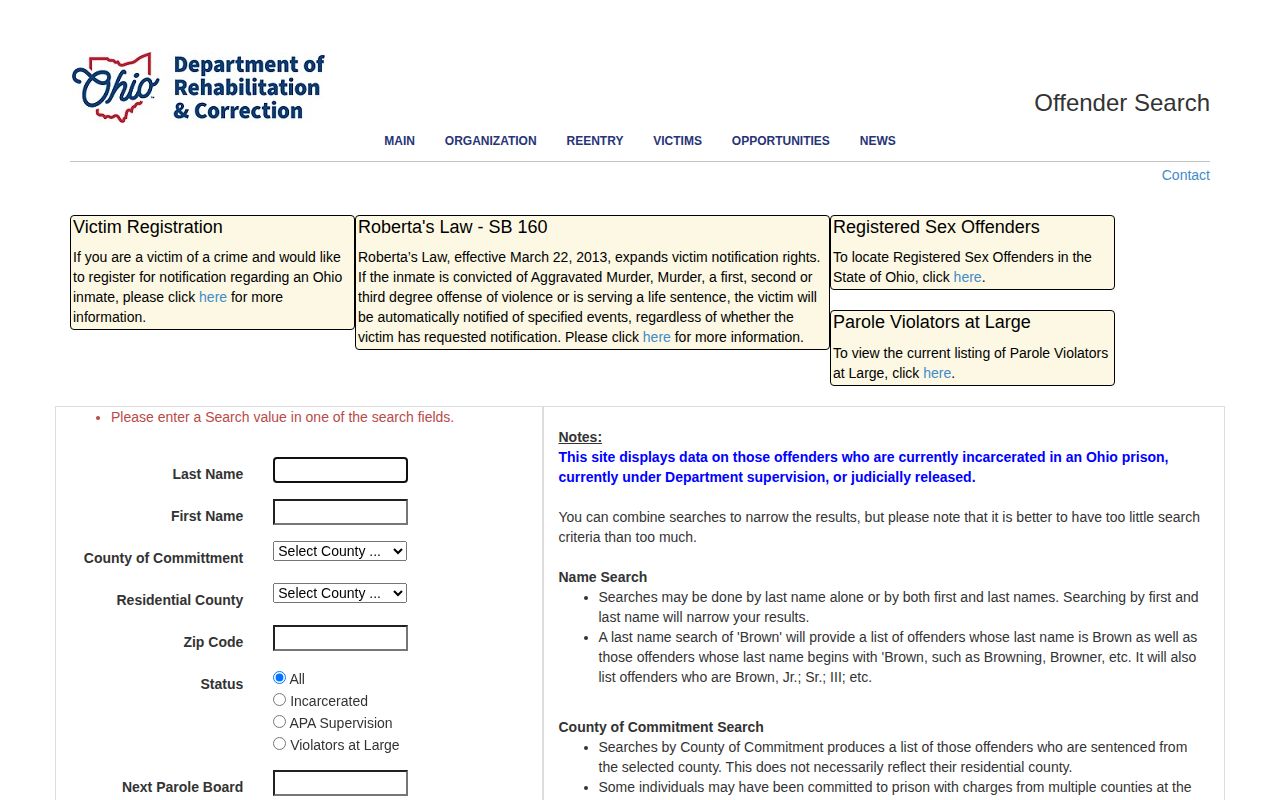
The result must be opened and matched by stable identifiers because the detail can distinguish prison custody, APA supervision, judicial release, and at-large status.
| Search field | Use | Important limit |
|---|---|---|
| Last and first name | Broad person search | Confirm DOB and ODRC number |
| Offender number | Most precise identifier | Use the required prefix and digits |
| County of Commitment | Finds reported sentencing county | May not reflect all simultaneous cases |
| Residential County | APA or VAL association | Last recorded area, not a current address |
| Status | Released, incarcerated, APA, or VAL | Search relevant statuses separately |
| Hearing month | Parole Board month in YYYYMM | A hearing date is not a release grant |
Note: Residential County in an APA or VAL result is a last recorded area, not a verified present address.
Marion Court Release Confirmation
Marion release research often requires two court systems. Marion Municipal Court records cover local misdemeanors, bond matters, traffic cases, and preliminary felony stages. The court warns that filings or judicial action may take at least 24 hours to appear online. Marion County Common Pleas eServices holds felony disposition, sentencing, community-control, and judicial-release entries.
Look for a bond or recognizance order, dismissal, judgment, jail-time credit, commitment, judicial release, warrant recall, or termination entry. A signed court entry is the best source for legal authority. It seldom proves the minute when physical release finished. Match it to the MCCC timestamp or ODRC detail. If the systems conflict, preserve both retrieval dates and ask each owner to reconcile the field it controls.
The Municipal Court search displays its own timing warning. Review the official court search source before treating a missing same-day entry as final.
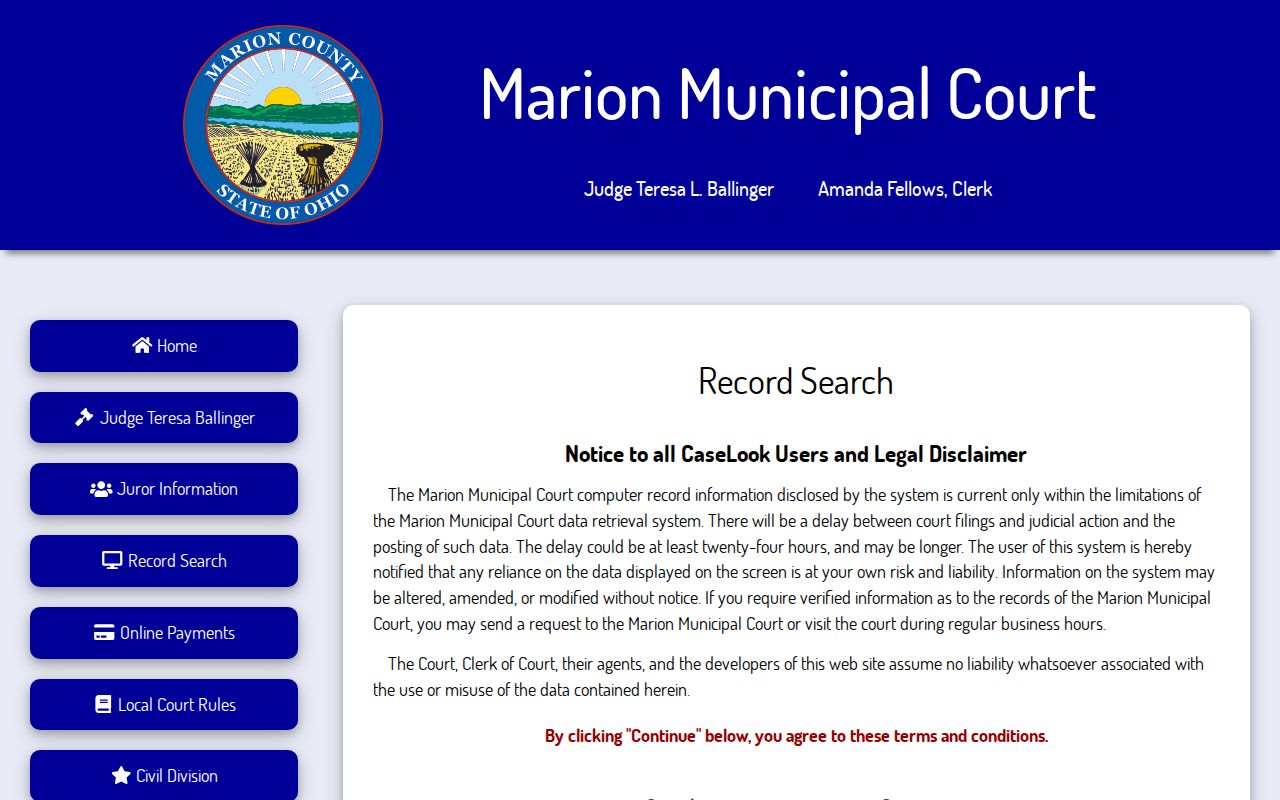
The warning explains why a same-day MCCC exit can occur before the matching public docket entry is visible.
Note: A journalized court order establishes legal authority, while the custodian's timestamp establishes when physical custody actually ended.
Marion Release Supervision and Alerts
ODRC's APA Supervision status can confirm that prison custody changed to parole, post-release control, or another Department-supervised posture. The detail may show supervision start, period, residential county, and APA office. Marion felony adult probation and Marion Municipal Court Probation cover court community-control cases that never required an ODRC prison release. Final discharge must come from the agency that supervised the person.
Ohio VINE provides free custody information and prospective alerts by web, phone, text, email, and VINEmobile. It covers county-jail and ODRC events with different event lists. A VINE release alert is a second signal, not a release certificate. Determine which agency sent it, then call MCCC or inspect ODRC and court records. A transfer alert should lead to the receiving agency, not a statement that the person is free.
Marion Release Reentry Resources
ODRC's coalition directory identifies the Mid-Ohio Reentry Coalition for Marion and Crawford. Kindway also documents its EMBARK program at Marion Correctional Institution for selected participants before and after release. These services may help with a transition, but neither is a person locator and neither proves that anyone has left custody.
Release and reentry records answer different questions. Verify the custody change first through MCCC, ODRC, the court, or the receiving agency. Use a named program only after its current eligibility and contact route have been confirmed.
Marion Federal Release Checks
No federal prison is located in Marion County, Ohio. “FCI Marion” is in Illinois and must not be confused with Marion Correctional Institution. When a federal case or transfer is documented, the BOP Inmate Locator can show a release date and a Released or Not in BOP Custody result for covered records. That status ends BOP custody only; another justice system or supervised release may still apply.
BOP generally covers federal inmate records from 1982 forward. Its results may also say Unknown when the confinement term has not been determined or In Transit while movement is underway. Neither label proves release. Older federal records may require the National Archives. A pretrial person held for the U.S. Marshals Service may not appear like a sentenced BOP inmate, so the federal court case, defense counsel, or USMS prisoner operations can be the sounder route. Pair any federal court release order with the holding facility's actual exit record.
An MCCC handoff to ICE would also be a transfer. No reviewed official source identifies MCCC as an ICE contract facility. Use the ICE Online Detainee Locator only when the transfer record or other reliable facts point there. It uses an A-number and country of birth, or exact name, birth date, and country. A missing result is not proof of release.
Marion County Release Facilities
Marion's custody map is unusually dense. MCCC is a regional adult jail. Marion Correctional Institution is a state-operated adult male prison. North Central Correctional Complex is an adult male prison run by a contractor under ODRC authority. North Central Ohio Rehabilitation Center is a juvenile community-corrections facility serving five counties. A person “in Marion” may have been committed by a court elsewhere, and a move between these systems may be transfer rather than release.
- Multi-County Correctional Center (MCCC): confirm current jail custody by phone and request the local release or transfer record.
- Marion Correctional Institution (MCI): use ODRC status, sentence, release, and APA records.
- North Central Correctional Complex (NCCC): use the same statewide ODRC authority, not MCCC.
- North Central Ohio Rehabilitation Center (NCORC): use authorized juvenile court or ODYS channels and respect confidentiality.
- Time served
- A sentence outcome in which credited jail time completes the term.
- Detainer
- A request or legal basis for another agency to take or keep custody.
- Discharge
- The formal end of the custody or supervision obligation at issue.
- Absconder
- A supervised person alleged to have left supervision; ODRC labels this status Violators at Large.
Note: Facility location alone does not establish commitment county, residence, or the court that controls a person's release.