
Marion County Release Date Types
A projected date is a calculation or legal milestone based on the record as it then exists. An actual release date is the time custody ended for that agency. The two can differ. Court corrections, earned credit, parole action, a detainer, or transfer processing can change what happens.
ODRC uses the exact field label Expected Release Date/Parole Eligibility Date. The slash matters. For some sentences, the field marks the first point at which parole may be considered, not an approved exit. Other details may show a POA/PRD Date, Supervision Start Date, jail-time credit, aggregate sentence, and a TC/TT Sentence Expiration for projected release from a halfway-house setting.
A pretrial MCCC detainee has no sentence-based release date. Bond or recognizance can create a legal path to release, but another hold or the facility's checks may delay or prevent the physical exit. A transfer from MCCC to ODRC also ends local jail custody without releasing the person into the community.
Scheduled is not actual. Treat an expected date or parole-eligibility date as a record to verify, never as a guaranteed release appointment.
Find a Marion County Release Date
The correct lookup depends on the custodian. MCCC is a regional county jail. Marion Correctional Institution and North Central Correctional Complex are ODRC prisons. Their shared geography does not make their records interchangeable.
- Identify the custody level from the court case or latest agency record. A Marion arrest or local jail term points to MCCC; an Ohio prison sentence points to ODRC.
- For state custody, search the ODRC Offender Search by last name or full offender number. Open the detail rather than relying on the result row.
- Read status, aggregate sentence, jail-time credit, Expected Release Date/Parole Eligibility Date, POA/PRD Date, hearing data, and supervision fields together.
- For an MCCC sentence, obtain the certified judgment, commitment date, court-calculated jail-time credit, and the jail's computation or release record.
- For a pretrial case, check bond and court orders, then call MCCC at 740-387-7434 and press 2. A docket order does not prove physical release.
- When a date is unclear, request the existing computation or release record from MCCC or ODRC Central Records.
ODRC detail pages direct sentence-computation questions to Central Records, P.O. Box 430, Columbus, OH 43216. Include the full name, ODRC number, commitment county or docket, and the specific existing record sought. Ask for the computation and source orders, not a new opinion about why a date moved.
Stable identifiers are essential when names match. An ODRC number and court docket help distinguish people with similar names. For MCCC, a booking number and approximate commitment date narrow the request. Record the date when an online field was viewed. If a later display differs, the two retrieval dates give ODRC, MCCC, or the court a precise issue to review.
The full local custody and release-record path is covered in the Marion County released inmates search.
Marion County ODRC Date Labels
ODRC definitions separate current status from sentence history. APA Supervision means the person has left prison under department supervision. Released is another searchable category. Incarcerated means prison custody continues. A detail may retain an institution or offense history after release, so status and supervision dates control the current reading.
| ODRC field | Responsible reading |
|---|---|
| Expected Release Date/Parole Eligibility Date | A sentence-dependent expected date or first parole-review milestone, not always an approved exit. |
| POA/PRD Date | A separately displayed ODRC date that must be read in its record context. |
| Supervision Start Date | Evidence that release from prison led into APA supervision. |
| Next Hearing/Review Month | A scheduled review period, not a release date. |
| Latest Hearing Result | The recorded outcome label; a continuation or full-board review is not a release grant. |
| TC/TT Sentence Expiration | The defined projected release point from a halfway-house or transitional setting. |
The official ODRC definitions page shows how Ohio describes statuses, sentence terms, and date fields.
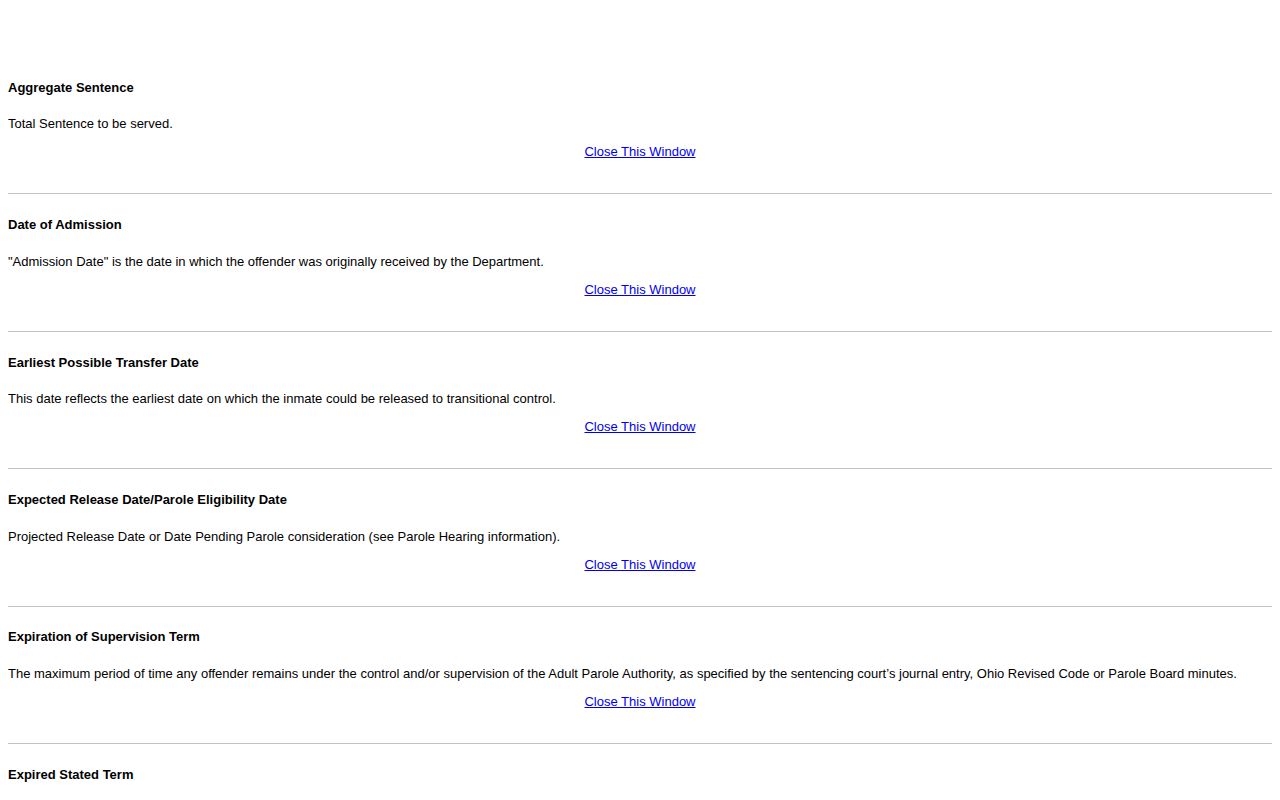
These definitions help prevent a parole-eligibility milestone from being reported as a fixed community-release date.
Note: Record the exact field label and retrieval date because the computation and current status can change after court or ODRC action.
Ohio Credit and Marion Release Dates
Ohio has no universal rule that every person serves a fixed percentage of a sentence. Sentence type, offense date, mandatory terms, statutory exclusions, earned credit, jail-time credit, parole rules, and court orders all matter. A public estimate should never replace the agency's current computation.
Ohio Revised Code 2967.194 governs current earned-credit treatment for confinement on or after its stated transition date. It authorizes provisional credit linked to qualifying education, vocational work, prison industries, substance-use treatment, and other DRC programming. The law contains category-based rates, caps, exclusions, administrative review, and authority to deny or withdraw provisional credit after rule violations.
Mandatory terms and specified violent, sex, or life sentences can be excluded or restricted. The predecessor statute, ORC 2967.193, may matter for confinement before the transition and used different monthly rates and aggregate limits. Neither law supports a simple automatic discount for every Marion County prisoner.
The current earned-credit statute appears in the captured source below.
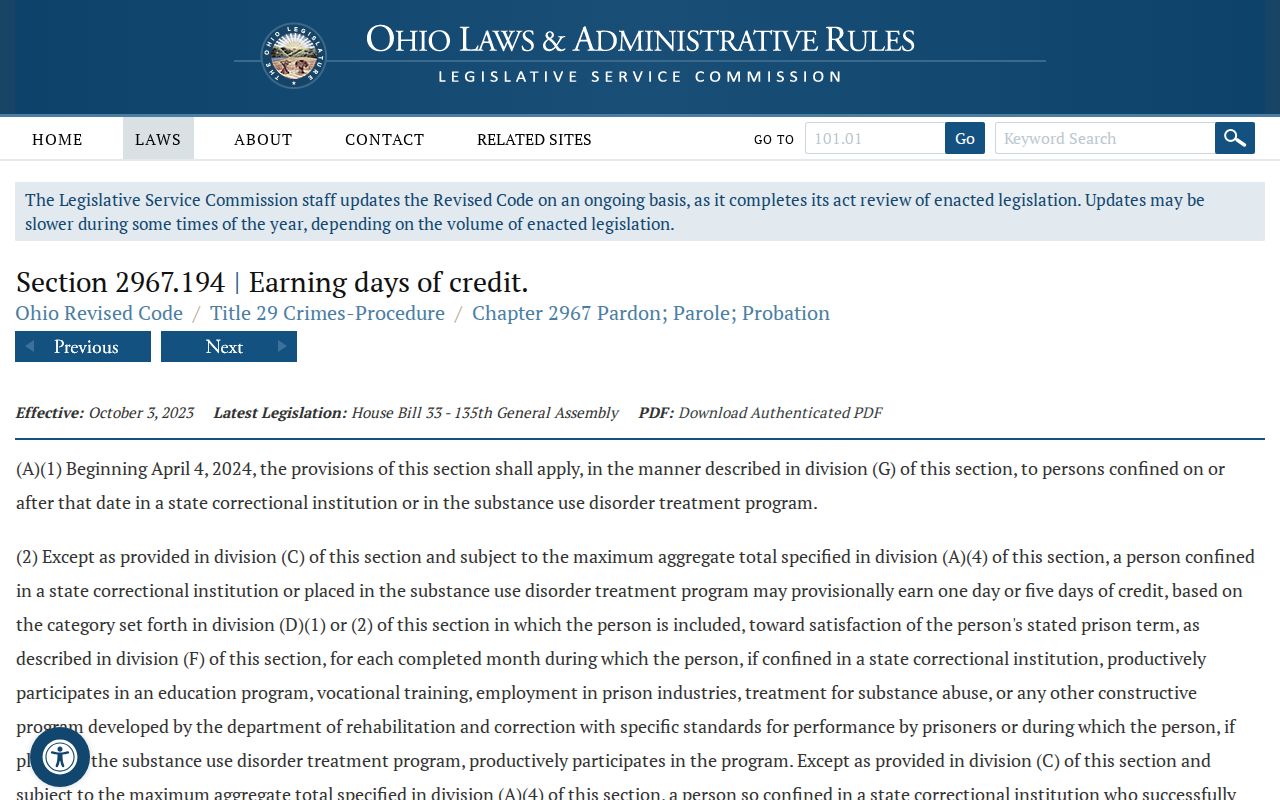
The statute supplies the rule framework, while ODRC's individual computation supplies the date for a named state prisoner.
Jail-time credit is another distinct input. The sentencing court supplies the credit calculation, while the custodian applies the judgment within the sentence record. A corrected credit entry can move a date without any earned-credit event. Productive-program credit, court-awarded jail-time credit, and parole eligibility should therefore remain separate in any Marion County release-date explanation.
Marion County Parole Eligibility Dates
Parole eligibility is not release approval. ORC 2967.13 sets first eligibility points for specified life and old-law sentences. The Parole Board then considers suitability. A result can be a grant, denial or continuation, deferment, full-board review, or another later review. Consecutive sentences can alter the eligibility calculation.
Some life sentences become eligible after a statutory minimum. Life without parole and certain other terms do not. These categories cannot be reduced to a general county formula. Read the judgment, offense-date law, aggregate sentence, and ODRC hearing fields.
Ohio's non-life indefinite framework can involve minimum and maximum terms with a statutory presumption and procedures, not a single unconditional exit. Post-release control may begin after prison under ORC 2967.28. Judicial release under ORC 2929.20 can move an expected date after a court order. Transitional control may move someone into closely monitored community confinement before term expiration.
A future hearing month is a calendar marker. A grant must still be followed through processing and any POA/PRD or supervision-start entry. For notice of a pending custody event, the Marion County VINE Inmate Check explains registration and corroboration.
MCCC Sentence Release Computation
A local jail sentence follows a different record path from an ODRC term. Begin with the certified Marion court judgment. Match the commitment date, court-calculated jail-time credit, consecutive or concurrent terms, and any later modification. Then obtain MCCC's computation and actual release record.
Do not apply ODRC program-credit rates to MCCC. Bond time, other cases, detainers, and court orders can affect when the person physically leaves. A Common Pleas sentence to ODRC turns the MCCC exit into a transfer, while the eventual community-release date belongs to ODRC.
Marion Municipal Court and Common Pleas answer different case questions. Municipal handles local misdemeanors, bond, and preliminary felony stages. Common Pleas handles felony sentence and judicial-release entries. The Municipal Court warns that web filings can lag at least a day, so the signed order and MCCC timestamp may not appear online at the same time.
A focused local request should seek the booking or commitment date, release or transfer date and time, authority, receiving agency when applicable, and any existing sentence-computation record. That avoids asking the jail to create a narrative.
Bond also requires care. MCCC states that Marion Municipal Court cash or corporate bonds are handled at the facility, while Common Pleas bonds are posted at Common Pleas downtown. Payment can start processing, but it is not an actual release timestamp. Identity checks, another hold, or transport can affect the result. Confirm the docket and MCCC entry before reporting an exit.
Why Marion Release Dates Change
A date can move because the legal sentence or credit calculation changes. It can also remain accurate for one custodian while another agency takes immediate custody. The reason should be tied to a record rather than inferred from a late release.
| Factor | Possible effect | Best record |
|---|---|---|
| Jail-time credit correction | Changes the credited time and computation. | Court entry plus MCCC or ODRC recalculation. |
| Earned credit award or withdrawal | Can move an eligible ODRC expected date. | ODRC computation and administrative record. |
| Parole decision | Grant, continuation, or later review changes the path. | Board result and subsequent ODRC status. |
| Judicial release or sentence change | A court order can alter custody and supervision. | Journalized court order and release entry. |
| Detainer or separate warrant | The person may transfer instead of entering the community. | Release-to-agency field and receiving record. |
| Transitional control | Moves a person to monitored community confinement before expiration. | ODRC status, program, and sentence-expiration fields. |
When official records conflict, preserve each field with its retrieval date. The court owns the judgment. ODRC owns the state sentence computation. MCCC owns its physical release or transfer record. Ask the owner of the disputed field to reconcile it with the source order.
Confirm Marion County Actual Release
Confirmation needs the final agency event. For MCCC, use the exact release or transfer timestamp and authority. For ODRC, check the current status, supervision start, and release record. For a court-driven change, pair the signed order with the custodian's processing entry.
A passed expected date does not prove unlawful detention or a stale website. The displayed field may have represented parole eligibility, an earlier calculation, or a milestone changed by a later decision. Ask Central Records for the current computation and source records.
VINE can alert a registered person to release or transfer. It is not a release certificate. Follow an MCCC message with a call and dated record. Follow an ODRC message with the offender detail and, when needed, Central Records or the listed APA office.
Note: A transfer ends one agency's custody but does not prove that the person returned to the community.